

The Property Squeeze Is Starting to Spread
From war and oil shocks to weaker auctions, housing shortfalls, affordability strain and investor traps, this week’s issue looks at the pressures now piling up around Australian property. 
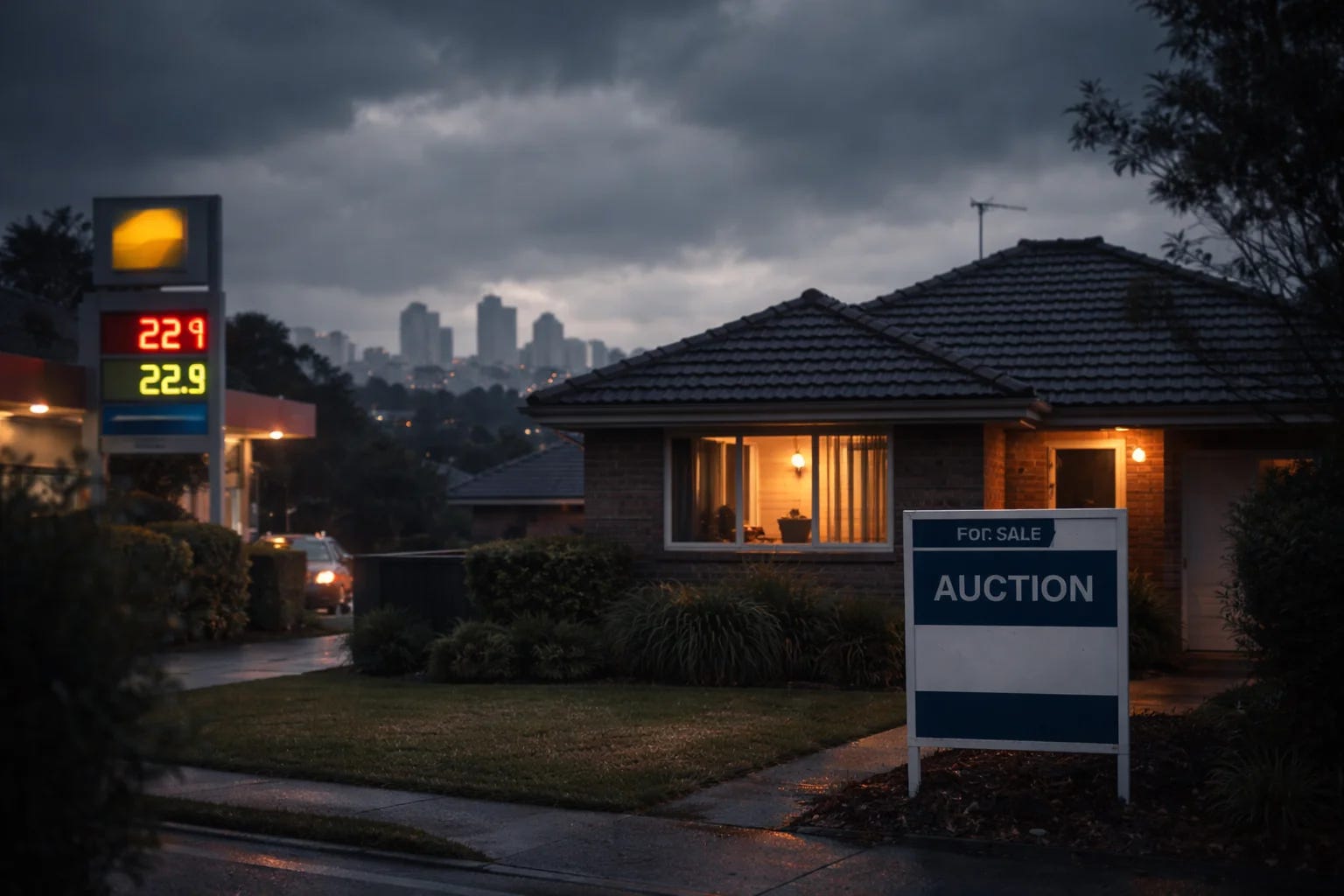
Today’s issue is about a market that is becoming harder to dismiss.
For a while, the property story could still be framed in neat categories. Rates were one problem. Supply was another. Affordability was bad, but familiar. Investors could still tell themselves that each risk sat in its own lane. This week’s Australian Property Review coverage points to something more uncomfortable: the pressure is no longer isolated. It is starting to spread across confidence, borrowing costs, construction, policy credibility and investor behaviour at the same time.
Some of those pressures begin offshore. Some are home-grown. But they all end up feeding into the same question for buyers, investors and households: what happens when a market already stretched on affordability has to absorb new shocks before the old ones are resolved? That is the thread connecting this week’s stories.
Here are the Australian Property Review pieces worth your attention.
1) The global shock risk is no longer abstract
The first cluster of stories is about how fast an external shock can become a domestic property problem.
APReview looked at how conflict involving Iran could derail Australia’s hoped-for soft landing, not because geopolitics automatically causes a housing crash, but because energy, inflation, sentiment and rate expectations can all turn quickly when a conflict hits oil markets. A related piece made the narrower investor point even more directly: an oil shock does not stay in commodities pages for long. It can flow straight through to inflation pressure and make life harder for a Reserve Bank that was already struggling to finish the job. And the building-cost angle matters too. If an overseas conflict lifts freight, energy and materials costs, the housing shortage becomes even harder to fix on the supply side.
Read:
Why the Iran war could wreck Australia’s soft landing
Oil Shock Hits Property Investors Where It Hurts Most: The RBA May Not Be Done Yet
How a war thousands of kilometres away could blow up the cost of building homes in Australia
2) The market is looking softer, but not safer
The second theme is domestic weakness showing up in more visible ways.
Australia’s auction market has lost momentum fast, with buyers pulling back under the combined weight of rates and war fears. At the same time, APReview argued that the housing squeeze is getting uglier, not easier, because the market is splitting in a way that leaves many households worse off even without a dramatic collapse. The wage story matters here too. Official wage growth can create the impression that households are gradually catching up, but the deeper affordability pressure remains far more severe when set against house prices and borrowing costs. In other words, softer conditions do not automatically mean relief. In some cases they just mean a weaker market sitting on top of the same affordability problem.
Read:
Auction market buckles as rates and war fears hit buyers
Australia’s housing squeeze just got uglier, and the next rate move could make it worse
The wage myth hiding Australia’s housing squeeze
3) Policy is still promising relief, but the numbers are not cooperating
A third thread this week was the growing gap between the housing story politicians want to tell and the one the numbers keep telling back.
Labor built serious political capital around housing, but APReview’s argument is that the supply promise is slipping while the gap keeps widening. That matters not just as a political embarrassment, but because every missed target leaves affordability pressure carrying more of the load. Another piece tackled the tax side of the same problem, arguing that policy settings have spent years nudging capital towards property, making it harder to buy in even while governments talk about access and fairness. The RBA reform piece sits in this same broader frame: institutional reform sounds clean on paper, but if outcomes remain messy, confidence in the policy apparatus weakens just when households need clarity most.
Read:
Labor’s housing promise is slipping and the gap is widening
Property tax perks are making it harder to buy in
Jim Chalmers sold the RBA shake-up as reform. The early verdict looks a lot messier
4) Investors are still being sold shortcuts that look easier than they are
One of the more important APReview themes this week was that investors can still get trapped by structures and strategies that sound efficient right up until the downside arrives.
The low-deposit story is really about how politically attractive entry schemes can mask balance-sheet risk when prices soften or rates stay higher for longer. The SMSF piece makes a different version of the same point: self-managed super can make sense, but only for people with the scale, clarity and discipline to use it properly. And the regional property piece showed how a trade that looked obvious in the work-from-home boom can become more fragile if fuel costs rise and distance starts to hurt again. In each case, the pattern is similar. What looks like access, flexibility or upside on the way in can turn into exposure when conditions change.
Read:
The 5 Per Cent Deposit Trap No One Wants to Talk About
When an SMSF makes sense, and when it can go wrong
Fuel shock could puncture the regional property trade
5) The noise investors are watching may not be the real risk
The final thread this week was about distraction.
AI is now being marketed to property investors as a faster way to screen deals, narrow options and move with more confidence. APReview’s warning was that AI can be useful, but it can also create false precision for people who do not understand what it cannot see. The related macro piece pushed the argument further: the real risk to Australian property investors may not be the loudest headline shock at all, but the deeper instability sitting behind debt, liquidity and the global financial backdrop. Even the Domain-REA battle fits this mood in its own way. On the surface it is a portal pricing fight. Underneath, it is a contest over power, margins and who gets to shape the economics of the property transaction itself.
Read:
The AI money trap catching property investors before they even make the call
The real threat to Australian property investors may not be war at all
Domain fires first shot at REA, but this price war is really about power
The bigger takeaway
These stories look different on the surface, but they point to the same lesson: the property squeeze is no longer just a rates story.
It is showing up in geopolitics, in construction costs, in policy drift, in investor behaviour, in fragile affordability, in weaker buyer confidence and in the shortcuts people reach for when the market gets harder to navigate. That is what makes this moment more difficult. The risks are not only getting bigger. They are starting to overlap.
That is the signal this week.
The next mistake in property may not come from missing the boom. It may come from underestimating how many pressures are now arriving at once.