

Rate cuts might not save you in 2026. Here’s how to buy anyway
Banks can’t agree on what happens next, but smart buyers are focusing on the things they can actually control.
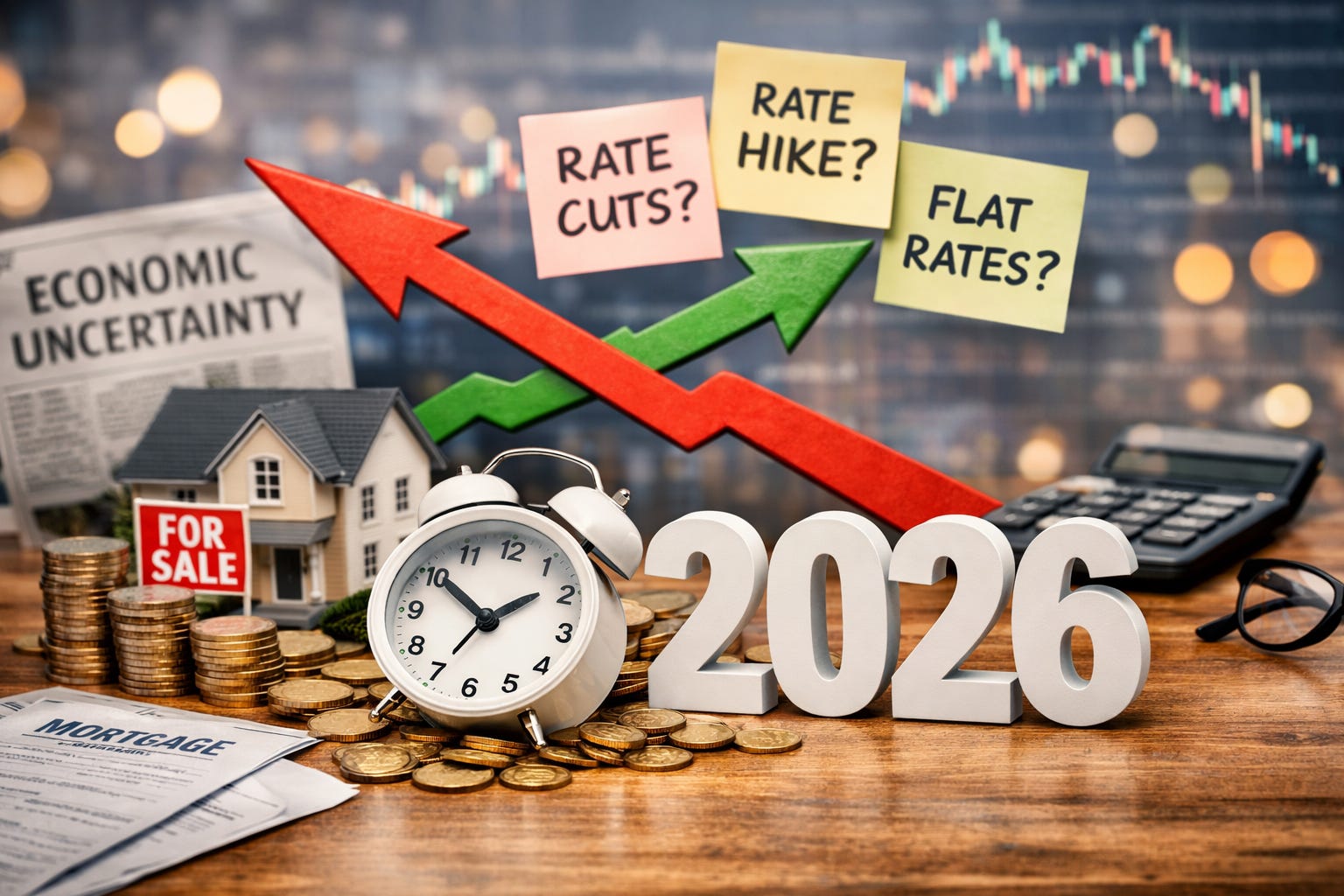
Rate-cut hype is a great headline because it gives everyone a simple plot: wait for cheaper money, then watch prices rip higher.
But the real world rarely plays along.
Rates can hold. They can stay higher for longer. They can even rise again. And the property market still moves, just not evenly. Some pockets run hot. Others cool off. Most buyers only find out which is which after they’ve already missed out.
Heading into 2026, the forecasts are messy. Some economists and banks still talk up the risk of further hikes. Others expect a long pause, then cuts later on. If you’re trying to time a purchase off headlines, you’re basically spinning a wheel.
So here’s the better approach: stop building your plan around one interest rate prediction and start building it around what you can control. Your suburb choice. The type of property you buy. The numbers that keep you safe if things don’t go your way.
The rate-cut story might be wrong, and that changes everything
A lot of buyers are sitting on their hands because they’ve heard the same line on repeat: cuts are coming, and when they do, prices will surge.
Sometimes that happens. Cheaper repayments can mean more borrowing power and more competition.
But the trap is treating one forecast like a guarantee.
If you buy, or delay buying, based on a single “rates are about to fall” narrative, you’re betting your timeline, borrowing capacity, and confidence on something you don’t control. Even the pros get it wrong.
The safer play is to stress-test your plan. If rates stay where they are, can you still afford the loan without living on two-minute noodles? If they rise a bit, do you still sleep at night? If they fall, does your strategy still work, or were you relying on “easy money” to rescue a deal that never really stacked up?
A good purchase should make sense without a rescue story.
Rates don’t only go up or down. They can go nowhere
Another mistake is thinking rates only have two settings. In reality, they can sit in a range for ages.
While people wait for a clear “cutting cycle”, the property market keeps moving in pockets. Some suburbs climb while rates are flat. Others soften even if rates ease.
That’s why big national predictions don’t help much when you’re trying to buy one specific property, in one specific location, at one specific price.
The focus needs to shift from “When will cuts arrive?” to “What can I do right now?” That means tightening your buying criteria, building a buffer, and targeting areas where demand is real and supply is tight.
Could rates hit 10 to 15 per cent? The practical point
Every cycle, someone asks the scary question: what if rates go back to 10 per cent, or even 15?
It grabs attention because it taps into memories of the 1980s. But there’s a modern problem that didn’t look the same back then: debt.
Australia is carrying far more debt across households, businesses and government than it used to. That makes the whole system more sensitive to shocks. So if rates ever pushed into double digits, it wouldn’t be just a “property problem”. It would hit household stress, business failures, and broader financial stability.
The takeaway is simple. Don’t build your strategy on doomsday numbers, but don’t pretend risk doesn’t exist either.
A sensible plan sits in the middle: assume less, buffer more.
That looks like running your budget as if rates are higher than today, not lower. It means keeping cash aside for repairs, strata surprises, vacancies, and life doing what it always does. It means buying on fundamentals, not hope.
The long view: prices rise through all kinds of rate settings
Zoom out far enough and property tends to climb over time. Not in a straight line, and not in every suburb, but often enough to remind buyers why “rates up equals prices down” is too simplistic.
Across different eras, prices have risen through rises, falls and flat stretches. Sometimes higher rates slow things down. Sometimes they barely dent momentum in areas where demand runs deep and stock is scarce. Sometimes prices dip, then recover faster than people expect.
The lesson isn’t “ignore interest rates”. It’s “don’t let one macro number become your whole strategy”.
Your outcome is usually decided by the micro stuff: what you buy, where you buy, and whether you overpay.
Inflation makes people chase hard assets, but it’s not automatic
Inflation changes behaviour because cash loses spending power. When everyday costs rise, some people look for “harder” places to park money, and property is usually high on that list.
That can lift prices if more buyers chase scarce stock. But it can also bring higher rates, which hits borrowing capacity and cools parts of the market. Both forces can show up at the same time, pulling in opposite directions.
Treat the macro stuff like weather. It matters, but it’s not the whole story. The goal for 2026 is to buy something that can handle more than one scenario, not just the one you’re hoping for.
Recession chatter is loud. Behaviour is louder
Recession talk gets noisy when people feel squeezed. It shows up at barbecues, in comment sections, and in every second headline.
But vibes are not data.
One of the better tells is household behaviour. If spending is holding up, people are still travelling, venues are still busy, and essentials are still moving through the economy, demand hasn’t fallen off a cliff. You can have genuine stress in some households and still have enough buyers with buffers to keep the market ticking over.
The property market is driven by the marginal buyer. If that buyer still has income, confidence and access to credit, activity can stay firmer than the doom headlines suggest.
Credit growth matters too. If borrowers keep entering the market, demand hasn’t vanished, even if commentary turns gloomy.
Markets within markets: suburb choice matters more than ever
When headlines say “the market is slowing”, they’re usually talking about an average.
Nobody buys an average house in an average suburb.
Even in a flat national year, you can have pockets where competition stays fierce because stock is tight, jobs are strong, schools are good, transport improves, or the lifestyle pull is real. At the same time, other pockets can soften due to too much new supply, fewer buyers at that price point, or properties that don’t match what most people actually want.
In uncertain rate periods, affordability can also outperform. When borrowing power is squeezed, buyers adjust in predictable ways. They compromise on size, travel time, renovations, or features. They shift to the next ring out. They move to markets with a lower entry price.
That’s why the “more affordable” end can keep turning over even when the top end hesitates.
Thinking about a buyer’s agent? Here’s how to compare properly
A buyer’s agent can be worth it, but only if they’re aligned with what you’re buying and how you want to buy.
Most charge either a fixed fee or a percentage of the purchase price. Percentage pricing is commonly quoted around 0.9 per cent to 3 per cent, depending on service level, location and complexity.
Fixed fee can feel cleaner because you know the cost upfront. Percentage fees can suit full-service searches where the workload rises with competition. Either can be fair. What matters is what you get for the money.
Before you sign, ask the questions that actually protect you:
Start with specialisation. Which suburbs and property types do they buy in, week after week? Are they focused on owner-occupiers or investors? Do they regularly buy at your budget level, or are you an outlier?
Then ask for recent examples and the logic behind them. They may not share addresses, but they can explain what made a deal good, what risks they avoided, and how they negotiated.
Get a clear list of what’s included. Searching, shortlisting, due diligence, pricing guidance, negotiation, and auction bidding can be packaged very differently. Make them spell it out.
Finally, ask directly about conflicts of interest. Do they take any selling-side incentives, referral fees, or developer payments? You want a clear “no”, plus a simple explanation of how they stay independent.
If the answers feel slippery, keep shopping. There are plenty of options, including comparison services that let you line up agents side by side so you can see who actually fits your brief.